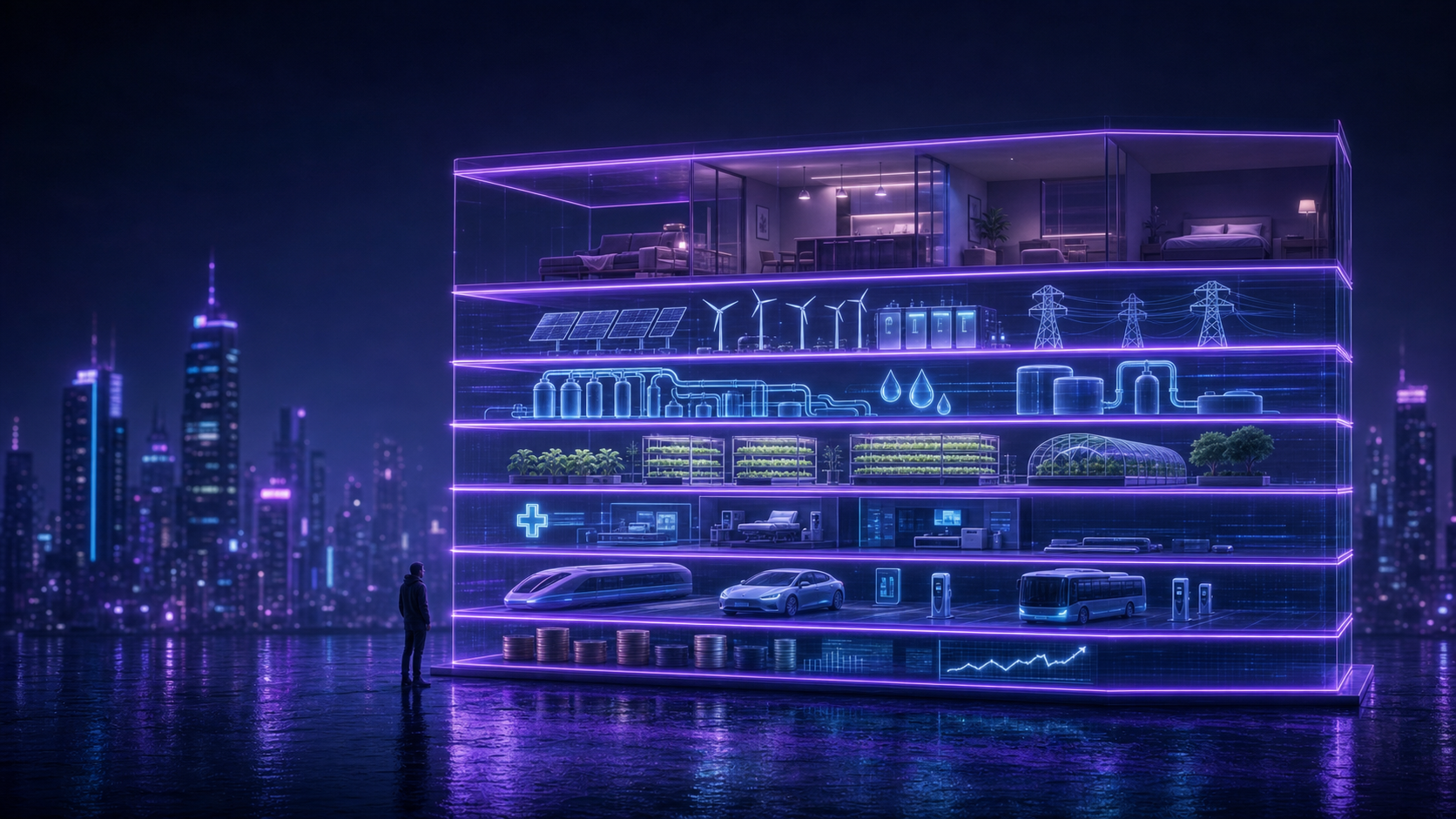
Material security
“How stable my foundation is and what happens when something goes wrong.”
Material security is one of the key dimensions of resilience. It determines what a person lives on in everyday life and what they can fall back on when conditions worsen. It is not just about income level or how much someone owns, but about how their environment is set up. What matters is whether their foundation can bear harder times and smaller and larger shocks.
It includes the ability to cover basic needs — housing, food, energy, transport, healthcare and everyday expenses. As well as a certain degree of buffer and stability that determines whether an unexpected expense, loss of income or life change immediately throws someone into difficulty, or „only“ forces them to adjust, reset and reorganise.
An important part of material security is a financial reserve. Not surplus money, but resources not earmarked for regular consumption, kept precisely for when something goes wrong — loss of income, illness, a major repair, a household breaking down. A reserve gives time and space to find a solution, think and negotiate, rather than having to take the first available, often unfavourable option. Those with no reserve depend on everything running „perfectly“. As soon as one element changes, a significant part of their functioning is at risk.
“How stable my foundation is and what happens when something goes wrong.”
How a person lives matters just as much. Material security does not depend on whether housing is owned or rented, but on its sustainability. Housing that is financially manageable even in a worse scenario is one thing; a situation where costs can only be paid on the condition that everything else works out „perfectly“ is another. Housing built on the edge can look fine while nothing happens, but is in reality fragile. This also includes whether a real alternative exists — a smaller or cheaper flat, a different city, a temporary stay with family or the option to spend more time outside a large city.
Material security does not play out in just one flat or one city. It helps if a person has another place where they can be — a smaller town, a village, a cottage. Not as a romantic „escape to the countryside“, but as a real base that can be moved to if needed and lived in for a while. A place with water, heat, basic services, ideally internet and some possibility to earn at least partly or reduce costs. Such a second base can ease the budget in harder periods and gives the feeling of not having just one single option for how to live.
Related to this is self-sufficiency from one's own resources. It does not mean cutting oneself off from the world, but having at least something „under one's own roof“. It might be a patch of garden, a few vegetable beds, herbs on the balcony, involvement in a community garden, a reasonable store of non-perishables at home, the ability to fix small things in the flat, or a simple backup source of heat and light for short outages. Each such small thing reduces dependence on everything always arriving from a shop or coming as a service, and gives more calm when something gets stuck for a while.
Work and income are a significant part of material security. Security of work today does not mean a job for life, but rather transferability. The ability to apply one's skills in different contexts, with different employers, in other cities or forms of cooperation. Material resilience reduces dependence on one employer, one narrow field or one location. What can increase it is a set of skills usable elsewhere, contacts outside one's own institution, or a small „second leg“ of income to lean on if needed. It does not have to be large, but it gives the reassurance that if things change, a person will not be left completely without a source.
Mobility also belongs to material security. Mobility is not just a matter of comfort, but of independence. It is not about „having a car“, but about not being entirely tied to one type of transport, one fuel, or one specific person who has to drive you. The ability to walk a certain distance, cycle somewhere, use public transport or a combination creates real room to respond. It determines whether you can even get to the places that represent your base — work, family, a cottage, your own garden.
Material security does not only create comfort, but above all space for decision-making. Those who live long-term on the edge, where every higher bill, minor breakdown or partial income loss means immediate threat, are under constant tension. This pressure does not only appear when a problem arises — it is present continuously. A person then acts more reactively, according to what must be managed immediately rather than what makes sense in a longer horizon. This narrows options, drains energy and shows up in other areas of life too.
In harder periods the importance of this dimension becomes even clearer. Loss of income, illness, a break-up or another life change affects differently a person who has a reserve, sustainable housing, some self-sufficiency, the option to be away from the city for a while and mobility, compared to someone who was already functioning on the edge and dependent on „everything around running“. Where material foundation is missing, problems do not add up — they multiply. Where some base exists, there is a greater chance of weathering the situation and finding orientation again.
This dimension therefore says not just how much a person has, but how their functioning is set up: whether it depends on nothing going wrong, or whether it accounts for the fact that sometimes something does go wrong and it is still possible to remain functional.
Story from practice
It was an ordinary January. Cold outside, an energy bill in the post, and a school message about rising lunch prices. We were sitting at the table at home, the children doing homework, my husband and I with coffee and our banking app open. We just wanted to check after Christmas how much we had dipped into savings and what the next few months looked like.
We knew the numbers. We knew how much we earned and roughly how much we spent. What hit us in that moment was something different: how little space there actually was between them. Once we laid out the regular payments for housing, energy, school, transport and everything else that simply has to be paid, what remained disappeared before we could even call it a „buffer“. On paper we were „fine“, but one larger extra expense and the whole thing would start to crack.
The expense did not take long to arrive. The boiler broke down. Not a catastrophe — just an amount labelled in everyday life as an „unpleasant surprise“. Suddenly we were deciding whether to dip into money we had mentally already earmarked for summer, take a loan, or ask our parents. The options were there, but none of them felt like a calm choice. More like improvisation under pressure.
On top of that all the small things almost everyone knows: shopping that just about fits the budget because „this month happened to work out“, quick online orders, the feeling we could afford another after-school club or a bigger car when there had not been a major repair for a while. All of it together created the impression of stability. Only when several things piled up at once did it become clear how little it takes for the whole thing to start wobbling.
In the end nothing dramatic happened that January. The boiler got fixed, the bills got paid, we kept going to work. But something changed. I stopped counting on things „just working out“ and started noticing what our sense of being „fine“ was actually built on. How little reserve we have when something extra comes up. How much we take for granted things that are not guaranteed. And how reassuring it is to start taking small steps so that one stumble means only a minor complication — and does not wipe us out.