How the resilience research was developed
The research was developed in response to a growing need to measure how people cope in challenging conditions — not just at the state level, but directly at the individual level. It drew on academic literature, expert interviews and pilot testing in the Czech Republic.
The result is a methodologically rigorous tool that makes it possible to compare resilience across countries and track its development over time. The entire research process, data and findings are documented on the Solvo website.
Individual Resilience Index
We drew inspiration from country-level resilience indices that include objective factors such as GDP, environment and education. But a resilient country is only as resilient as its population, which is why we created a unique resilience index that measures individual resilience.
Methodology
Methodology
The Resilience Index was built on quantitative research targeting individuals directly. The goal was to construct a tool for assessing personal resilience and comparing it across European countries.
Research focus
Although resilience is frequently studied, prevailing research focuses primarily on the macro level (states, institutions or economies), while individual-level resilience remains less explored.
This research focused directly on individuals. The aim was to construct a Resilience Index based on quantitative research to evaluate the Czech population, forming the basis for a system to assess individual personal resilience.
The Individual Resilience Index was then tested on representative population samples from four European countries (Czech Republic, Slovakia, Germany, Sweden) to identify factors in which populations differ or are similar. This is a comparative quantitative study using primary sociological survey data.

Data collection
| Country | N | Method |
|---|---|---|
| CZCzech Republic | 1 235 | CAWI (620), CAPI (615) |
| SKSlovakia | 1 000 | CAWI |
| DEGermany | 1 000 | CAWI |
| SESweden | 1 000 | CAWI |
Interview length (LOI): 20–35 minutes. Target population: age 16–75.
Index construction
60
Items in the questionnaire
questions & statements
8
Resilience dimensions
assessment areas
226
Maximum score
total points
The Resilience Index was created by summing the point values of responses to 60 items divided into 8 dimensions. Individual items were scaled and converted to standardised scores.
No sociodemographic characteristics (gender, age, education) were included in the index. The index represents the subjective resilience assessment of respondents.
| On a scale of 0 to 10, how strongly do you feel overall resilient against stress, strain and adverse situations? | 0 | 1 | 2 | 3 | 4 | 5 | 6 | 7 | 8 | 9 | 10 |
|---|---|---|---|---|---|---|---|---|---|---|---|
| 1% | 1% | 5% | 5% | 6% | 16% | 16% | 18% | 18% | 8% | 6% | |
| 18% | 50% | 32% | |||||||||
8 dimensions of resilience
Weight of each dimension in the overall index.
Hypotheses and findings
The initial hypothesis was that individual countries would differ in their resilience index. Sweden was expected to rank first with values around 110–115 points, Germany second (105–110 points), and the Czech Republic third ahead of Slovakia.
The resulting order was predicted correctly, but the index values of individual countries differ only minimally. The explanation cannot be found in significant distribution differences — median values and min/max ranges do not explain this.
Confirmation that Sweden deserves first place is found in maximum values — some individuals reached 197 points, significantly more than in other countries. Nearly 5% of Swedes achieve a markedly above-average index (more than 146 points), compared to 2.5% in the Czech Republic and just under 2% in Slovakia.
Health data were surprising: average Swedish BMI was lowest but still nearly 26. The average WHO mental health index was 15.3 — comparable to Czech Republic and Slovakia. In Sweden 27% of people have this index at the threshold for mental health problems; in Czech Republic it is as high as 30%.
A new hypothesis emerges: are European countries similar in resilience because they share a very similar lifestyle? Or is it due to the geographic proximity of Central and Northern Europe? How would Poland (facing immediate threat), Italy, Spain or Ukraine fare?
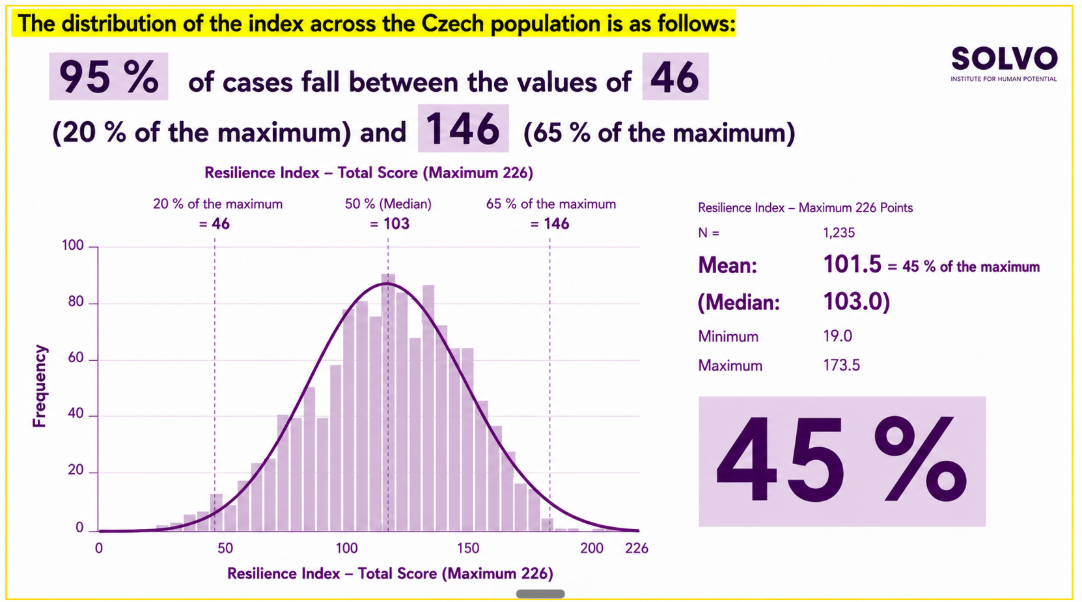
Distribution of the Resilience Index (max 226 points) in the Czech population. N = 1,235. Mean: 101.5 points (45% of maximum). 95% of cases fall between values 46 and 146.
Subjective resilience
How the index is formed
The Resilience Index is formed by combining several dimensions — your overall resilience reflects how you perform in each area. But we can also simply ask people: do you feel resilient, and how much? Try to place yourself on a scale from 0 to 10, there's nothing to it. Each person then evaluates their own resilience based on what they consider more or less important in their concept of resilience — some prioritise physical fitness, others their mental state, others their skills and knowledge.
Only 2% of people perceive their resilience at 0 or 1 — very low or none. In contrast, 6% gave a value of 10 and another 8% gave 9. Half the population perceives themselves as averagely or slightly above-averagely resilient.
Given the overall resilience index results, it seems we tend to root for ourselves — or (more likely) we don't include everything in our self-assessment, such as things we're not good at. Instead, we give greater weight to areas where we feel confident.
And how does it turn out when we compare subjective resilience with the overall resilience index encompassing all dimensions? Both values correlate very strongly — people who subjectively perceive their resilience as low achieve well-below-average values, while those who see themselves as fully resilient also have a high index.
| On a scale from 0 to 10, how strongly do you feel resilient against stress, burden and adverse situations? | |||||||||||
|---|---|---|---|---|---|---|---|---|---|---|---|
| 0 | 1 | 2 | 3 | 4 | 5 | 6 | 7 | 8 | 9 | 10 | |
| Resilience index - average | 79 | 67 | 76 | 81 | 85 | 94 | 104 | 108 | 111 | 115 | 115 |
To what extent is subjective resilience assessment related to health indicators such as BMI or the WHO mental health index? It is evident that people who rate their own resilience as low are more likely to face problems with overweight and mental health difficulties.
| On a scale from 0 to 10, how strongly do you feel resilient against stress, burden and adverse situations? | |||||||||||
|---|---|---|---|---|---|---|---|---|---|---|---|
| 0 | 1 | 2 | 3 | 4 | 5 | 6 | 7 | 8 | 9 | 10 | |
| BMI | 29 | 26 | 28 | 28 | 26 | 26 | 26 | 26 | 27 | 27 | 26 |
| WHO index (mental health, max. 25 points) | 9 | 10 | 11 | 12 | 12 | 14 | 15 | 16 | 17 | 17 | 18 |
What does this mean? We can trust people to estimate their own abilities and perceive resilience as a more complex matter — one that includes weaknesses alongside strengths. It is therefore valuable to show concrete examples of how resilience can be increased even through seemingly simple changes we make in life.